Posts

Bt Corn Seed Selection in Light of Resistance in Corn Rootworm

Image
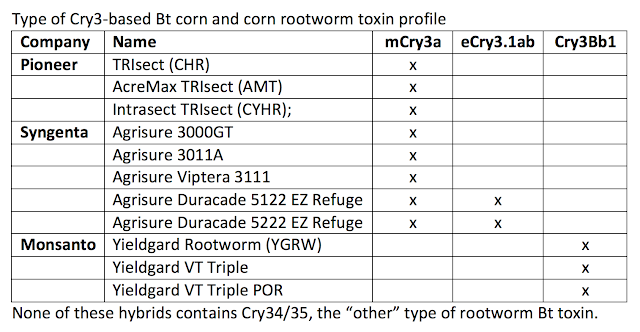
By Patrick Porter and Ed Bynum, Extension Entomologists in Lubbock and Amarillo, respectively.  The August 25th edition  of this newsletter discussed how our mCry3a Bt corn was no longer able to control western corn rootworm in an area from Hart, Texas, north to the top of the Panhandle. In that newsletter, even though we were seeing all of the classic signs of resistance, we used the term �probable resistance�, only because our laboratory assays on field collected beetles will not be completed until next year.  In addition to mCry3a, that newsletter suggested that since there is cross resistance between all of the Cry3-type toxins (mCry3a, eCry3.1Ab and Cry3Bb1), none of these toxins could be expected to provide good control of western corn rootworm. Dr. Aaron Gassmann at Iowa State University, a leading authority on corn rootworm resistance, said, �Cry3Bb1, mCry3A, and eCry3.1Ab all appear fairly similar to the rootworm. Resistance to one is likely to confer resistance ...

Good News: Some Single Toxin Bt Corn Being Withdrawn from the Market

Dr. Chris DiFonzo, Entomologist at Michigan State University and author of the Handy Bt Trait Table, and I got a note from a corn seed dealer a couple of weeks ago concerning the removal of some single toxin Bt corn hybrids from the market after 2019. Apparently there was a letter circulating from one of the seed companies to this effect, and he wanted to know whether it was true and, if so, why it was being done - some of his customers really like their single toxin hybrids.  It is true, and it is a good and necessary thing. Back when Bt corn was first introduced, most hybrids had only a single toxin for caterpillar pests, and, a few years later, if there was a corn rootworm toxin it was single as well. A few more years down the road, seed companies began selling �pyramids� of toxins; a combination of two or more toxins targeted at a pest. Not only did this improve efficacy, but it also slowed the rate of resistance development as explained in the following scenario.  If inse...

Virus-Based Insecticides for Control of Headworms in Sorghum and Caterpillars in Other Crops

A "new" insecticide option is being tried and promoted on the High Plains for control of some caterpillar pests, especially sorghum headworms (corn earworm and fall armyworm). There are some appealing aspects to this, but there is a lot we don't know as well. Dr. Ed Bynum just posted a nice summary of the history of these insecticides based on nucleopolyhedrovirus (NPV), how they work, and some aspects of application and labeling.  Insecticidal Virus Products for Pest Control: What are the Latest Facts , Panhandle Pest News, 7 November 2018. Because these are live viruses and spread in the field, the minimum plot size needed for research is very large. We would be interested in trying one or both of these headworm products on large fields next year. By large I mean way bigger than we have at the Experiment Station. There would be large blocks of treated and untreated sorghum, and ground application equipment would be essential.

Assessing the Value of Bt Corn When Insects Are Resistant - Part I: Corn Rootworm

Image
We are entering a time when insects have become resistant to many of the Bt toxins in our GMO corn and cotton. This is the first in a series of articles where I will discuss what this might mean in terms of crop damage and the value of the Bt technologies.  To start the series, I want to make it clear that Bt crops are more than just insect protection; they are herbicide tolerance, cold tolerance, and improved genetics for yield, drought and disease tolerance. These other virtues remain even when the insect control fails, although reduced insect control clearly can affect some of them, like yield potential and drought tolerance.  Back in the early days of Bt crops, seed companies defined and charged a "technology fee" that was added to seed cost; growers knew what they were paying for insect protection. Those days are long gone, for various reasons, and now the seed cost is what it is and there is no way to know how much is being paid for the Bt traits.  While we don't kn...

Terms We Will Soon Use in Discussing Resistance to Bt (GM) Crops

It has been quite a challenging summer with our Bt crops on the Texas High Plains. This year we have seen huge numbers of corn rootworms emerging from many fields planted to mCry3a, a corn rootworm Bt toxin that has been used year after year in continuous corn. These fields had significant root pruning caused by rootworm larvae and produced a large number of adults � survivors of the toxin.  We have also seen corn earworm do significant damage to Bt corn that worked well a few years ago, and we have documented Bt cotton with unexpectedly high levels of bollworm damage and large larvae surviving the Bt toxins. In each case we collected insects from the field and sent them for laboratory assay to determine if the insects were resistant to the Bt toxins in the crops. These assays take time, but it is highly probable that in a few months we will be reporting that resistance has been confirmed in corn rootworm and corn earworm/cotton bollworm.  To help explain what is going on in n...

Texas Panhandle Corn Rootworm Probably Resistant to Some Bt Corn

Image
There were a crazy lot of western corn rootworm beetles emerging from continuous corn fields this summer in the Texas Panhandle, and with seed purchase decisions on the horizon it might be a good idea to talk about Bt resistance.  For two years now, Dr. Ed Bynum, Extension Entomologist in Amarillo, and I have seen extensive damage to Bt corn with the toxin mCry3a. These fields have been found in the zone from Dalhart in the north to Hart in the south.  We have been seeing all the textbook symptoms of a failed Bt rootworm toxin:  growers using soil applied insecticides in addition to their Bt seed, heavy root damage, plant lodging, lots of adult beetles on the wing because they were not killed as larvae feeding on roots, and aerial spraying of adult beetles to try and kill them before they clip silks or lay eggs that will become rootworm larvae the following year. This year we received phone calls from consultants around Hart that were alarmed at the huge numbers of beetle...

What's Up With All the Earworms in Bt Corn?

This is a jointly issued article from Extension Entomologists Drs. Pat Porter (Lubbock) and Ed Bynum (Amarillo). There are large numbers of corn earworm larvae in Bt corn ears in the Texas Panhandle, and some people are spraying in an attempt to control them.  The first question we are getting is what to spray, but the better question would be whether to spray.  Corn earworm is usually an ear tip feeder, and on its own is seldom an economic pest of corn. However, this year we are seeing earworms doing more than just tip damage, and feeding lower in the ear. The reason(s) for this change in behavior are unknown.  We have not forgotten last year though, when there was good evidence that just a little ear tip damage resulted in higher fumonisin levels. This could happen again this year, especially if the weather in August and September turns off wet and relatively cool. However, based on what we saw last year, the little bit of tip damage needed to promote fumonisin has alre...

Bollworm situation: West Texas cotton

Image
I am glad folks are paying attention to what is happening in other areas. I had a few calls regarding bollworms this week--mostly in response to the hubbub in Central and South Texas. So far, worm pressure in cotton have remained light for the most part with some areas (e.g. parts of Swisher, Floyd, and Hale counties) just starting to show increase in numbers. Our Bt sentinel research plots at Texas A&M AgriLife Research and Extension center in Lubbock are showing a few worms in non-Bt plots�no activity has been spotted in any of the Bt technology plots so far. As the season progresses, we may see increase in moth flights and the egg lay. I wouldn�t spray for bollworm egg lay in West Texas cotton as very few eggs make it to worms (thanks to beneficials!). Treatment decisions should be made based on the amount of fruit injury and the presence of live worms in both Bt or non-Bt fields. Since newly hatched larvae must feed on the plant for the Bt toxin to be effective, delay decision ...

Sugarcane Aphid Arrives on the Texas Southern High Plains

Kerry Siders, EA-IPM in Hockley, Cochran and Lamb counties, just reported that Danny Quisenberry, a crop consultant, found sugarcane aphids on older grain sorghum four miles north of Earth in northern Lamb County. Additionally, Greg Cronholm, a private crop consultant, just reported sugarcane aphids on sorghum in southern Castro County. Neither of these populations is at a treatable level, just small colonies on isolated plants at present. If this year's infestation pattern follows those of 2014-2017, then it is likely the aphids are already present in Hale, Floyd and Lubbock counties, although we have had no reports of this as yet.

Sustained High Numbers of Fall Armyworm Moths

Image
This week's fall armyworm pheromone trap graph appears below. The 7-year average for this week of June is 110 moths per week. This week's capture was 707. This does not appear to be a phenomenon confined to the Lubbock Research Center, as Katelyn Kesheimer, EA-IPM in Lubbock and Crosby counties, reported several hundred moths in the Crosby County traps she operates. (Rain filled the traps so it was not possible to count all the moths, but there  were hundreds.) Additionally, Blayne Reed, EA-IPM in Hale, Swisher and Floyd counties, drove to Plainview from College Station late last week and reported that fall armyworm moths were very abundant at rest stops along the way. A prior post from April of this year discussed some genetic work being done by Ashley Tessnow, a graduate student in the Dept. of Entomology at College Station. She determined that the Lubbock area fall armyworm moths we sent her last year were 30% rice strain and 70% corn strain as a season average. She also no...

Fall Armyworm Trap Captures Very High at Lubbock

Image
My post two days ago said fall armyworm captures in pheromone traps were a bit above average and that it seemed we were at the start of a big flight. The traps were emptied on Wednesday, and today they had an average of 215 moths per trap. To put this in perspective, the 7-year average for this week of the season is 115 per WEEK. So in just two nights the capture we are already 87% above the historical weekly average. There is no way to know if the numbers will remain at their current level for five more nights, but if they did then next Wednesday I would report 752 moths per trap. Regardless of how things go for the next five days, we are now well above the 7-year average. My non-Bt corn is taking significant damage, and this is before most of the caterpillars are anywhere near large. Egg masses are easy to find. The good news is that fall armyworm is not generally a big problem very far north of Lubbock. My colleagues and I checked research plots with non-Bt corn at both Halfway and ...

Mid-June: Mostly Good for Corn and Sorghum, Fall Armyworm High

Image
It is mid-June, and I am pleased to report that there have not been any serious insect problems in corn and sorghum yet. Well, let me temper this by saying that the drought has brought plenty of problems outside the entomological realm. Wireworms have been a problem in spotty areas, but for the most part seed treatments have kept them in check. Corn in the area is approaching V6 - V8, and sorghum is anywhere from V5 to still in the bag. Sugarcane aphids have not been detected on the High Plains, but sorghum planted relatively late will benefit from seed treatments to control sugarcane aphids, at least if prior years are a predictor. The progress of sugarcane aphid can be tracked here . Fall armyworm trap captures just jumped up, and the weekly average exceeds the 7-year average at Lubbock . We may be at the start of a big flight; last night's capture was 124 moths per trap, whereas the nightly average for the prior six nights was only 25.4. I have non-Bt heirloom dent and sweet cor...

Should I be on the lookout for thrips?

Image
I have noticed some thrips damage on the early planted cotton especially in the areas north of Lubbock. Fields that have already reached 4 true-leaf stage are pretty much safe from further thrips damage. We still, however, have a lot of late-planted cotton in South Plains that ranges from emergence to 1 st or 2 nd true-leaf stages which are very prone to thrips injury. Late planted cotton usually escapes peak thrips flight but the fields at the most vulnerable stages especially those in the vicinity of maturing wheat or pastures will have to be watched closely for thrips. In general, with the current hot and mostly sunny days, I would not be too aggressive when it comes to spraying as cotton plants can outgrow thrips under good growing conditions. Having said that, I wouldn�t wait too long either if the damage is being done. Spraying for thrips after the 3 rd true-leaf stage contributes little towards the yield�so the timing is critical! What are thrips? Thrips are early-season pests...

Wireworms in Texas High Plains Cotton

Image
I have received a few queries regarding wireworms lately. Here is some info to answer some of the common ones. What are wireworms Wireworms are a common cotton pest which feed on germinating  se eds and emerging seedlings. Two types of wireworms feed on cotton: true wireworms and false wireworms. True wireworms, commonly called click beetles, are members of the Elateridae family, while false wireworms, or darkling beetles, are from the Tenebrionidae family. Click beetle Darkling beetle Damage Wireworm larvae (Photo: Pat Porter) Overwintering larvae inflict the most damage as they become active in the spring. The larvae damage cotton by feeding on the root, hypocotyl (stem of the germinating seedling), and cotyledon (seed leaves) of plants before emerging from the soil. Root feeding can kill plants and reduce plant stand but usually results in stunting. Scouting It�s hard to find crop worms that you can�t see! Soil-dwelling habit of larvae makes it very challenging to scout for. Bai...

As Crop Threats, All High Plains Fall Armyworms Are Not The Same

Image
We all respect fall armyworm as a significant threat to High Plains corn, sorghum and cotton, and that is why we run pheromone traps to assess the potential threat during the growing season. Last year we sent some of our moths to Ashley Tessnow, a graduate student working with Dr. Greg Sword in the Dept. of Entomology at College Station. She is looking at the population genetics of fall armyworm. She sent some of her preliminary results this week, and they were a surprise; based on just 2017 moths, we seem to have a baseline level of around 30% "rice" strain. There are two strains of fall armyworm, and the rice strain feeds on rice, Bermudagrass and Johnsongrass (but can feed on corn). The "corn" strain feeds on corn, sorghum and cotton. In another surprise, the baseline level of about 70% corn strain jumped to 93% in the late June sample when we had a sudden influx of high numbers of moths for just a few days.  I sent Ashley a draft of this text, and she wisely add...

All New Guide to Manage Cotton Insects is Now Available

Image
Entomologists with Texas A&M AgriLife Extension Service have released a new statewide guide on managing insect pests of cotton. The highlights of new guide include 1) description of economic arthropod pests of cotton in Texas, including their associated damage to crop growth stages, 2) description of the various sampling methods for these pests, 3) information on Bt traits available in market and their relative efficacy, and 4) description of action thresholds and management tools for each pest. Here is a link to access online version of the guide. https://lubbock.tamu.edu/files/2018/01/Cotton-Insect-Management-Guide.pdf It can also be downloaded from the Texas A&M AgriLife Extension bookstore at no cost. http://www.agrilifebookstore.org/Managing-Cotton-Insects-in-Texas-p/ento-075.htm

Texas Receives Section 18 for Transform for Control of Plant Bugs in Cotton

Suhas Vyavhare, Extension Cotton Entomologist, Texas A&M AgriLife Extension Service The EPA has approved the Section 18 Emergency Exemption for use of Transform WG in Texas to control plant bugs in cotton. This exemption is effective March 1, 2018 and expires October 31, 2018. Pests and application rates: Plant bugs (1.5 � 2.25 oz Transform WG per acre) Spray drift management: Applications are prohibited above wind speeds of 10 mph Restrictions: -    Pre-harvest Interval: Do not apply within 14 days of harvest. -    A restricted entry interval (REI) of 24 hours applies to all applications. -    Minimum Treatment Interval: Do not make applications less than 5 days apart. -    Do not make more than four applications per acre per year. -    Do not make more than two consecutive applications per crop. -      Do not apply more than a total of 8.5 oz of Transform WG (0.266 lb ai o...

Bt Corn Update, and New Bt Trait Table Published

As final seed purchases are being made in the Texas Panhandle, here is a brief update on the status of Bt corn. But before your eyes glaze over from the discussion below of new Bts and resistance to older Bts, I want to highlight a publication that makes it easy to tell which toxin packages and herbicide traits are in which type of corn. Dr. Chris DiFonzo at Michigan State University publishes the annual " Handy Bt Trait Table for U.S. Corn Production ", and the 2018 version was posted online today. (I am a contributor to this publication, but Dr. DiFonzo does the heavy lifting.)  In just two pages she lists the types of Bt present in all commercialized corn in the U.S.A., and the table presents the trade names for traits, Bt event, protein(s) expressed, targeted insects and herbicide traits. The 2018 Trait Table also lists the insect x Bt combinations with documented field-failures, confirmed resistance, or cross-resistance. These statements are based on published lab assays...